NetSuite Starter Edition vs Sage 50 vs QuickBooks: The UK & Ireland Comparison
Choosing the right business software is one of the most critical decisions you'll make for your growing business in the UK or Ireland. With NetSuite Starter Edition, Sage 50, and QuickBooks all vying for your attention, how do you cut through the marketing noise to understand what's truly best for your business?
As the 3EN Group, having implemented over 200 NetSuite projects across 50+ countries from our offices in Belfast, Holywood, and London, we've helped dozens of businesses migrate from both Sage 50 and QuickBooks. We understand the fundamental differences – not just what's on the spec sheets, but what matters in daily operations across the UK and Ireland.
Understanding the Fundamental Architecture Differences
Before diving into features, it's crucial to understand that these are fundamentally different types of software:
NetSuite Starter Edition:
True cloud-native ERP (Enterprise Resource Planning)
Single, unified database for all business data
Real-time processing and reporting
Browser-based access from anywhere
Automatic updates and maintenance
Sage 50:
Desktop-based accounting software with cloud features
Requires installation on servers or computers
Limited to accounting and basic inventory
Needs third-party integrations for CRM, manufacturing
Manual updates and IT maintenance are required
QuickBooks Online:
Cloud-based accounting software
Primarily financial management-focused
Limited operational capabilities
Suitable for basic business needs
Automatic updates but limited customisation
Core Functionality Comparison
Let's examine what each system actually delivers out of the box:
Financial Management
NetSuite Starter Edition:
Complete general ledger with real-time reporting
Multi-currency with automatic revaluation (essential for UK/Ireland trade)
Advanced revenue recognition
Budget vs actual reporting
Automated bank reconciliation with UK and Irish banks
Fixed asset management
Sage 50:
Traditional double-entry bookkeeping
Multi-currency is available in the Professional version only
Basic financial reporting
Manual bank reconciliation
VAT management and MTD compliance (UK)
Limited to 2 users (Standard) or up to 20 (Professional)
QuickBooks:
Cloud-based accounting
Multi-currency from Essentials plan upward (£28/month+ UK pricing)
Basic to intermediate reporting
Automated bank feeds from UK/Irish banks
VAT filing to HMRC (UK) and Revenue (Ireland)
Making Tax Digital compliant
Inventory & Order Management
NetSuite Starter Edition:
Real-time inventory tracking
Multiple location support
Automated reorder points
Drop shipping capabilities
Lot and serial number tracking
Integrated with financials
Sage 50:
Basic stock control is available in the Professional version only
Single or multiple locations
Manual reorder management
Limited integration with other modules
Requires add-ons like Cim50 for manufacturing
QuickBooks:
Basic inventory tracking (Plus plan £47/month+ only)
Limited to simple stock items
No manufacturing capabilities
Basic reorder reminders
Single location tracking
Customer Relationship Management (CRM)
NetSuite Starter Edition:
Fully integrated CRM included
360-degree customer view
Lead and opportunity management
Marketing automation basics
Customer service case management
Email marketing capabilities
Sage 50:
Basic contact management only
No CRM functionality
Requires third-party integration (additional cost)
Limited customer insights
No lead tracking or pipeline management
QuickBooks:
Basic customer tracking
No true CRM capabilities
Limited to transaction history
Requires integration with external CRM
Basic contact management
Scalability: The Hidden Differentiator
This is where the real differences emerge:
NetSuite Starter Edition:
Seamlessly scales to Mid-Market and Enterprise editions
No data migration required when upgrading
Add modules as you grow
Supports international expansion
Handles complexity without performance degradation
Sage 50:
Maximum 20 users on Professional
Limited transaction volumes
Requires migration to Sage 200 for growth
Performance degrades with data volume
UK and Ireland tax compliance only
Limited multi-location capabilities
QuickBooks:
Scales through plan upgrades
Limited customisation options
Performance issues with high transaction volumes
Requires workarounds for complex businesses
Better than Sage 50 for scaling, but still limited
Separate versions for the UK and Ireland markets
Integration Capabilities
Modern businesses need connected systems:
NetSuite Starter Edition:
Open API for unlimited integrations
Pre-built connectors for major platforms
With 3EN's Unio platform: seamless integration with any system
Real-time data synchronisation
No middleware required for most integrations
Sage 50:
Limited API access
Requires middleware for most integrations
Not truly cloud-based, complicating integrations
32-bit ODBC limitations
Often requires manual data export/import
QuickBooks:
Good API and app marketplace
750+ app integrations available
Cloud-based enables easier connections
Some limitations on data access
Additional costs for many integrations
Total Cost of Ownership: Beyond the Sticker Price
Let's address pricing realistically without getting into specific numbers that change frequently:
NetSuite Starter Edition:
Higher initial investment
All-inclusive functionality
No need for multiple systems
Lower IT maintenance costs
Predictable scaling costs
Sage 50:
Lower initial cost
Additional costs for: hosting, add-ons, integrations, IT support
8% annual price increases announced
Hidden costs in manual processes
Migration costs when outgrown
QuickBooks:
Moderate monthly costs
Add-on costs accumulate quickly
Transaction limits on some plans
Integration costs
Less hidden costs than Sage 50
The User Experience Reality
NetSuite Starter Edition:
Modern, browser-based interface
Role-based dashboards
Mobile access included
Consistent experience across all modules
Customisable without coding
Sage 50:
Dated Windows-based interface
Limited customisation options
No true mobile access
Inconsistent experience across modules
Requires IT support for changes
QuickBooks:
Modern, intuitive interface
Good mobile apps
Limited customisation
User-friendly for basic tasks
Can become cluttered with complexity
Industry-Specific Considerations
Software & Technology Companies (prevalent in Dublin, London, Belfast):
NetSuite: Subscription billing, project tracking, and revenue recognition built in
Sage 50: Requires multiple add-ons
QuickBooks: Basic capabilities, needs integrations
Wholesale Distribution (across UK & Ireland):
NetSuite: Complete inventory, order management, drop shipping
Sage 50: Limited capabilities even with Professional
QuickBooks: Basic inventory only at higher tiers
Professional Services (major sectors in both markets):
NetSuite: Project accounting, resource management, time tracking
Sage 50: Very limited project capabilities
QuickBooks: Basic project tracking in the Plus plan
Making the Decision: Key Questions to Ask
Choose NetSuite Starter Edition if:
You're planning significant growth
You need integrated operations beyond accounting
You operate multiple channels or locations
You trade between the UK and Ireland or internationally
You want to eliminate manual processes
You need real-time visibility
You're thinking long-term ROI over initial cost
Consider Sage 50 if:
You're a very small, single-country business
You only need basic accounting
You have simple operations
You're comfortable with desktop software
You don't mind eventual migration
You only operate in either the UK or Ireland
Consider QuickBooks if:
You need cloud-based accounting
You have simple business processes
You're budget-conscious, short-term
You prefer user-friendly over feature-rich
You're okay with multiple systems
You operate in one jurisdiction only
The 3EN Perspective: Why Architecture Matters
Having worked with businesses across the UK and Ireland migrating from both Sage 50 and QuickBooks to NetSuite, we see consistent patterns:
From Sage 50:
Relief at escaping server-based constraints
Surprise at how much manual work was eliminated
Appreciation for real-time visibility
Ability to manage operations across the UK and Ireland seamlessly
Regret at not moving sooner
From QuickBooks:
Excitement about integrated operations
Improved team collaboration across multiple offices
Better decision-making with unified data
Single system for UK and Irish operations
Significant efficiency gains
The Migration Reality
From Sage 50 to NetSuite:
Clean break from legacy architecture
Opportunity to redesign processes
8-10 week typical timeline with 3EN
Historical data migration included
From QuickBooks to NetSuite:
Smoother data migration (cloud to cloud)
6-8 week typical timeline
Process optimisation opportunities
Immediate efficiency gains
Future-Proofing Your Decision
Consider where technology is heading:
Cloud-Native is Non-Negotiable:
Sage 50: Not truly cloud-based
QuickBooks: Cloud-based but limited
NetSuite: Built for the cloud era
AI and Automation:
NetSuite: AI capabilities expanding rapidly
Sage 50: Limited AI potential
QuickBooks: Basic automation only
Integration Economy:
Modern businesses need connected systems
NetSuite: Designed for integration
Sage 50: Struggles with modern integration needs
QuickBooks: Good but limited
The Bottom Line
While Sage 50 and QuickBooks serve their markets, NetSuite Starter Edition is fundamentally different – it's a platform for growth, not just a tool for accounting. The initial investment is higher, but the returns in efficiency, visibility, and scalability make it the wise choice for ambitious businesses across the UK and Ireland.
For businesses operating in both jurisdictions or planning expansion, NetSuite's unified platform eliminates the complexity of managing separate systems for different tax regimes.
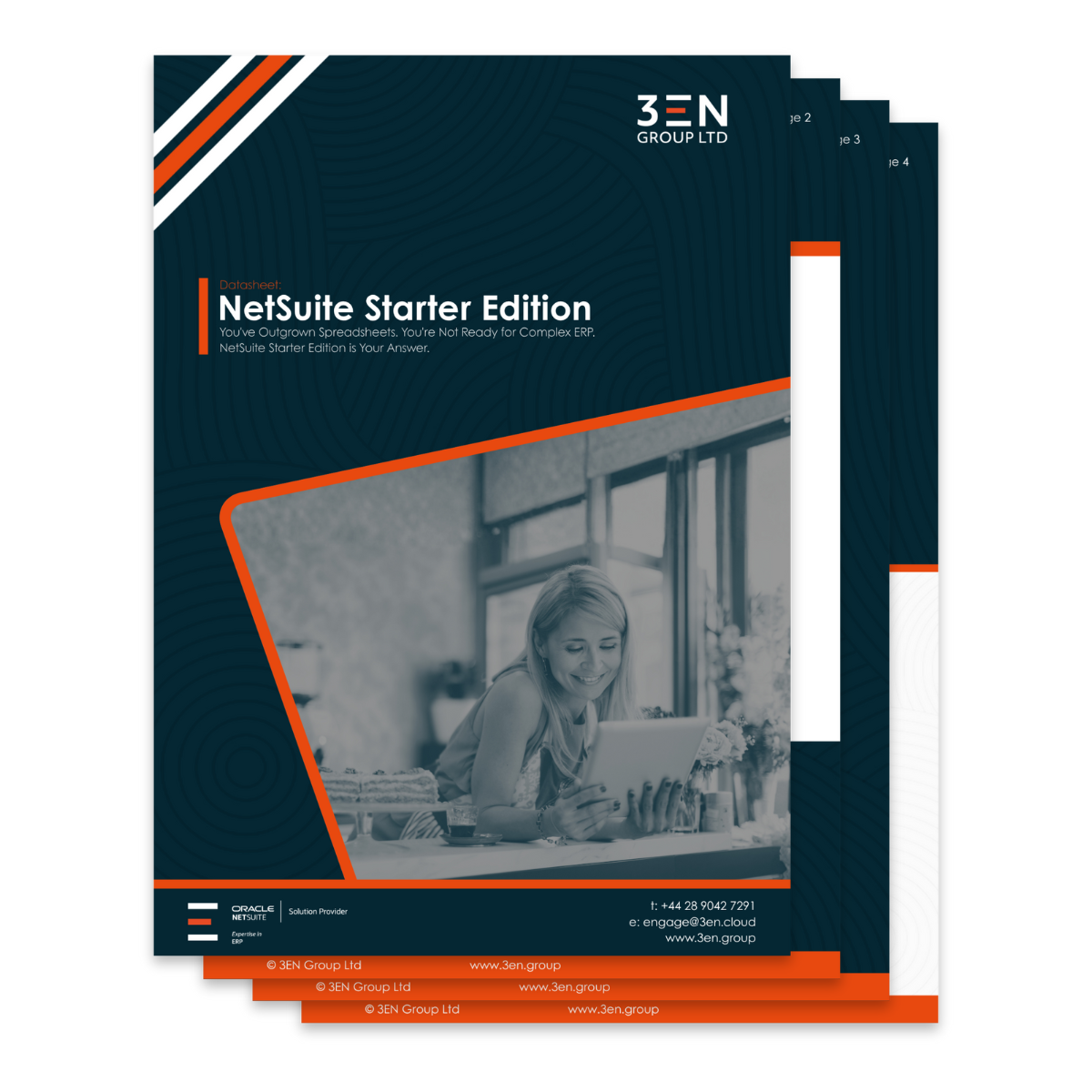
Your Next Step
Don't choose based solely on price. Choose based on where you want your business to be in 3-5 years from now. With 3EN Group's expertise and the power of NetSuite, you're not just buying software – you're investing in transformation.
Ready to move beyond basic accounting?
Click the button below to learn more about NetSuite Starter Edition or book a Free Discovery Consultation.