Why NetSuite Starter Edition is the Smart First Step to Cloud ERP
The shift to cloud-based business systems is no longer a question of "if" but "when." For UK and Irish SMBs still running on spreadsheets, desktop accounting software, or disconnected systems, the question is how to make that transition without the complexity, cost, and risk traditionally associated with ERP implementations.
NetSuite Starter Edition answers that question. Designed specifically for growing businesses ready to graduate from basic tools to enterprise-grade systems, it delivers the power of the world's most widely adopted cloud ERP in a package built for SMBs.
In this article, we explore why cloud ERP matters, what makes NetSuite the leading choice, and how Starter Edition provides the ideal entry point for ambitious UK and Irish businesses.
The Case for Cloud ERP
Cloud ERP has fundamentally changed what's possible for small and medium businesses. Where enterprise resource planning was once the exclusive domain of large corporations with dedicated IT departments and substantial capital budgets, cloud deployment has democratised access to these powerful tools.
The advantages are well documented. Cloud-based systems eliminate the need for expensive servers, reduce IT overhead, and shift capital expenditure to predictable operating costs. But the benefits extend far beyond cost savings.
Real-time visibility across your business
With cloud ERP, all your business and financial data can be accessed in one place, in real time. This visibility provides you with the insights you need to adapt your business and sustain continuous growth. No more waiting for month-end reports to understand your position.
Accessibility from anywhere
Your team can work from the warehouse, the office, or remotely – using laptops, desktops, or smartphones. For businesses with distributed teams or multiple locations, this flexibility is transformative.
Automatic updates and maintenance
Cloud ERP providers handle system maintenance and upgrades, eliminating the burden on internal IT resources. Your system stays current without disruptive upgrade projects.
Enterprise-grade security
Reputable cloud ERP vendors implement advanced security measures that most SMBs cannot match with on-premise solutions. Encryption, multi-factor authentication, and compliance with data privacy regulations are built in.
Scalability without disruption
As your business grows – adding users, expanding to new locations, or increasing transaction volumes – cloud systems scale seamlessly. There's no need to replace infrastructure or migrate to new platforms.
Why NetSuite Leads the Cloud ERP Market
With over 40,000 customers worldwide operating across 219 countries, NetSuite has established itself as the leading cloud-native ERP solution for small to midsize businesses. This isn't by accident.
NetSuite was purpose-built for the cloud from its inception in 1998, years before the term "cloud computing" became common. While other vendors have retrofitted legacy systems for cloud deployment, NetSuite's architecture was designed from the ground up for web-based access and multi-tenant delivery.
A unified platform
NetSuite integrates financial management, CRM, inventory, order management, and business intelligence in a single system. This eliminates the data silos that plague businesses using multiple disconnected tools. When your sales team creates an order, your finance team sees the revenue impact, your warehouse team sees the fulfilment requirement, and your management team sees the updated forecast – all automatically, all in real time.
Industry expertise built in
Nearly 28% of NetSuite's customers come from the professional services sector, with significant adoption in technology, wholesale distribution, manufacturing, and retail. This concentration enables NetSuite to deliver industry-specific functionality and best practices that generic accounting software cannot match.
Continuous innovation
Oracle's ongoing investment in the platform means customers benefit from regular enhancements without having to manage upgrade projects. Recent releases have embedded AI capabilities throughout the platform, including financial exception management and analytics assistance.
Proven implementation methodology
NetSuite's SuiteSuccess approach provides pre-configured solutions based on industry best practices, dramatically reducing implementation complexity and time to value compared to traditional ERP deployments.
NetSuite Starter Edition: Right-Sized for Growing SMBs
Full NetSuite implementations are robust but can be more than what a growing SMB needs – or can absorb – at the start of their cloud journey. That's precisely why Oracle created NetSuite Starter Edition.
Starter Edition delivers the core capabilities growing businesses need without the complexity of modules they're not yet ready to use. It's designed for companies with up to 10-15 users operating as a single legal entity – the profile of most UK and Irish SMBs in the £1M-£10M revenue range.
What's Included in Starter Edition
Financial Management
The foundation of any ERP system is financial management, and Starter Edition delivers enterprise-grade capabilities.
Your general ledger offers real-time reporting with the flexibility to tailor your chart of accounts to meet your business needs. Accounts payable and receivable are fully integrated, with automated workflows for approvals and payment processing. Multi-currency support handles the complexities of trading internationally – essential for UK businesses navigating post-Brexit trading relationships and Irish companies operating across Euro and Sterling markets.
Fixed asset management tracks depreciation and provides the audit trails that compliance requires. Financial dashboards provide leadership with instant visibility into their cash position, profitability, and key metrics, eliminating the need for manual report preparation.
Order and Inventory Management
For businesses selling products – whether through wholesale, e-commerce, or direct channels – Starter Edition provides the operational backbone.
Inventory tracking maintains accurate stock levels across locations. Order management handles the full quote-to-cash cycle, from initial quotation through order fulfilment and invoicing. Purchase order processing integrates with supplier management, providing visibility into what's on order and when it's expected.
This integration between sales, operations, and finance eliminates the manual reconciliation that consumes hours in spreadsheet-dependent businesses.
Customer Relationship Management
Unlike basic accounting software that treats CRM as an afterthought (or requires a separate system), Starter Edition includes essential CRM functionality as a core component.
Contact management maintains a complete history of every customer interaction. Opportunity tracking provides visibility into your sales pipeline. Sales force automation helps your team work efficiently. Customer service management ensures issues are tracked and resolved.
The integration between CRM and financials enables your sales team to view customer payment history and credit status when quoting, while finance can access the pipeline when forecasting.
Business Intelligence
Data is only valuable if you can access and analyse it. Starter Edition includes pre-built reports and KPIs that provide immediate insight without requiring technical expertise to configure.
Customisable dashboards allow each user to view the metrics most relevant to their role. Real-time analytics mean you're always working with current data, not last week's snapshot. Role-based access ensures people see what they need to see – and nothing more.
The ROI Reality
The investment in ERP must deliver measurable returns. Research consistently shows that cloud ERP implementations achieve meaningful ROI, though the specific figures vary based on business size, complexity, and how effectively the system is used.
According to NetSuite's own customer data, users have seen 40% to 60% improvement in order process efficiency following implementation, with 40% to 55% reporting reductions in reporting time. These efficiency gains translate directly to cost savings; the time your team currently spends on manual processes can be redirected to value-creating activities.
Industry benchmarks suggest that typical payback periods for cloud ERP implementations range from 12 to 18 months, with total cost of ownership 30-60% lower than on-premise alternatives over a 5-10 year period.
For the specific ROI calculation relevant to your business, our previous article, "The Hidden Costs of Not Having ERP," provides a framework for quantifying what inefficiency is currently costing you.
The Scalability Advantage
One of the most compelling aspects of starting with NetSuite Starter Edition is what comes next. Unlike switching between disconnected systems, where each transition requires data migration, retraining, and disruption, NetSuite is designed to grow with you.
When your business expands beyond the scope of the Starter Edition, you can upgrade within the platform. Your data stays where it is. Your team's training carries forward. Your customisations and configurations remain intact.
Need to add a subsidiary? Upgrade to Mid-Market Edition with OneWorld capabilities. Growing your user base? Simply add licenses. Ready for advanced manufacturing or project management? Activate the relevant modules.
This isn't just a theoretical benefit. Businesses that outgrow Starter Edition face a straightforward expansion, not a replacement project. The investment you make today continues delivering value as your business evolves.
Why Now? The UK and Ireland Context
For UK and Irish SMBs, the timing for cloud ERP adoption has never been more favourable.
Economic conditions support investment
According to recent UK business statistics, small business profitability has returned to pre-pandemic levels, with 78% of SMEs reporting profit in 2024. Businesses are well-positioned to invest in infrastructure that supports the next phase of growth.
Growth ambitions require better systems
UK government data indicates that over 40% of SMEs expect sales growth of 10-24% over the next three years, with many forecasting even higher growth. Spreadsheets and basic accounting software cannot support that trajectory.
Regulatory complexity is increasing
Making Tax Digital continues to evolve. Proper systems provide the audit trails, automated reporting, and compliance tools that growing businesses need.
Cross-border trade demands integration
For businesses operating across the UK and Ireland, or with European and international customers, unified systems eliminate the complexity of managing separate processes for different currencies and tax regimes.
The 3EN Group Difference
Selecting the right implementation partner is as important as choosing the right software. Research consistently shows that ERP projects delivered with experienced consultant support achieve significantly higher success rates than those implemented independently.
3EN Group brings unmatched expertise to NetSuite Starter Edition implementations.
100% implementation success rate
Across more than 200 NetSuite projects in 52 countries, we've never had a failed implementation. This isn't luck – it's a combination of methodology, experience, and a commitment to getting it right.
UK and Ireland expertise
With experience implementing NetSuite in over 50 countries worldwide, we understand the specific requirements of businesses operating in these markets. VAT, MTD compliance, multi-currency operations, cross-border trade – we've solved these challenges dozens of times.
Fixed-price implementation
The price covers everything: licenses, implementation, data migration, training for up to 10 users, and quarterly optimisation reviews. No hidden costs, no scope creep, no surprises.
Ongoing partnership
Implementation is just the beginning. Quarterly business reviews ensure that you continue to extract value as your business evolves. Our UK and Ireland-based support team is here when you need us.
Is Starter Edition Right for You?
NetSuite Starter Edition is designed for businesses that have outgrown basic tools but aren't yet ready for complex, multi-subsidiary ERP deployments. You're likely a good fit if:
Your annual revenue is between £1M and £10M
You have 5-15 employees who need system access
You operate as a single legal entity
You're currently managing on spreadsheets, Sage 50, QuickBooks, or similar tools
You lack real-time visibility into business performance
Manual processes are consuming time that should be spent on growth
You're planning to scale and need systems that can grow with you
If this describes your situation, the question isn't whether you need better systems – it's when you'll make the move.
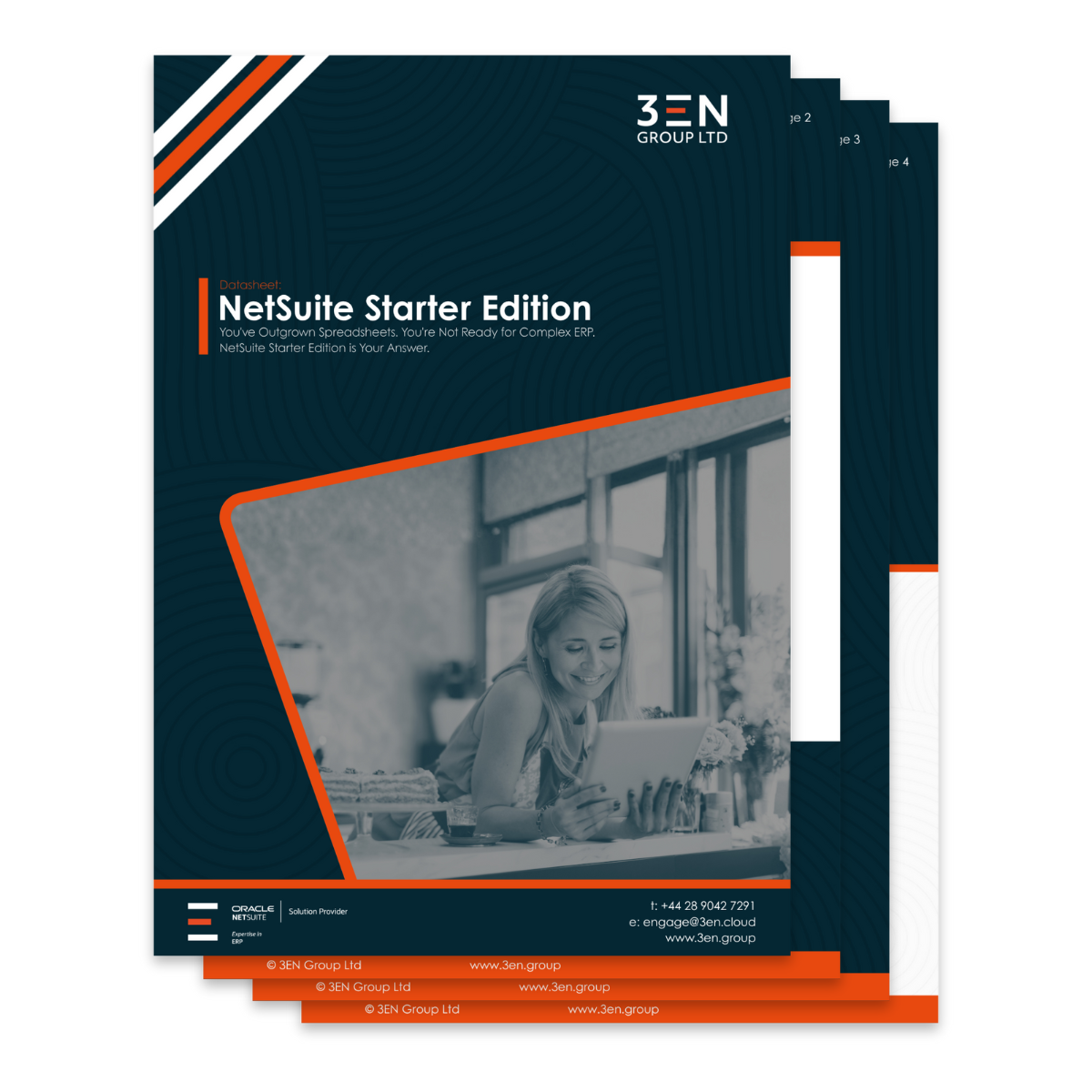
Take the Next Step
NetSuite Starter Edition represents the smart first step to cloud ERP, offering enterprise-grade capabilities without the complexity typically associated with them.
Book your free discovery call today to explore whether Starter Edition is right for your business.
This is the fourth article in our NetSuite Starter Edition series. Start with Part 1: What is NetSuite Starter Edition?, see the comparison in Part 2: NetSuite vs Sage 50 vs QuickBooks, and understand the ROI in Part 3: The Hidden Costs of Not Having ERP.